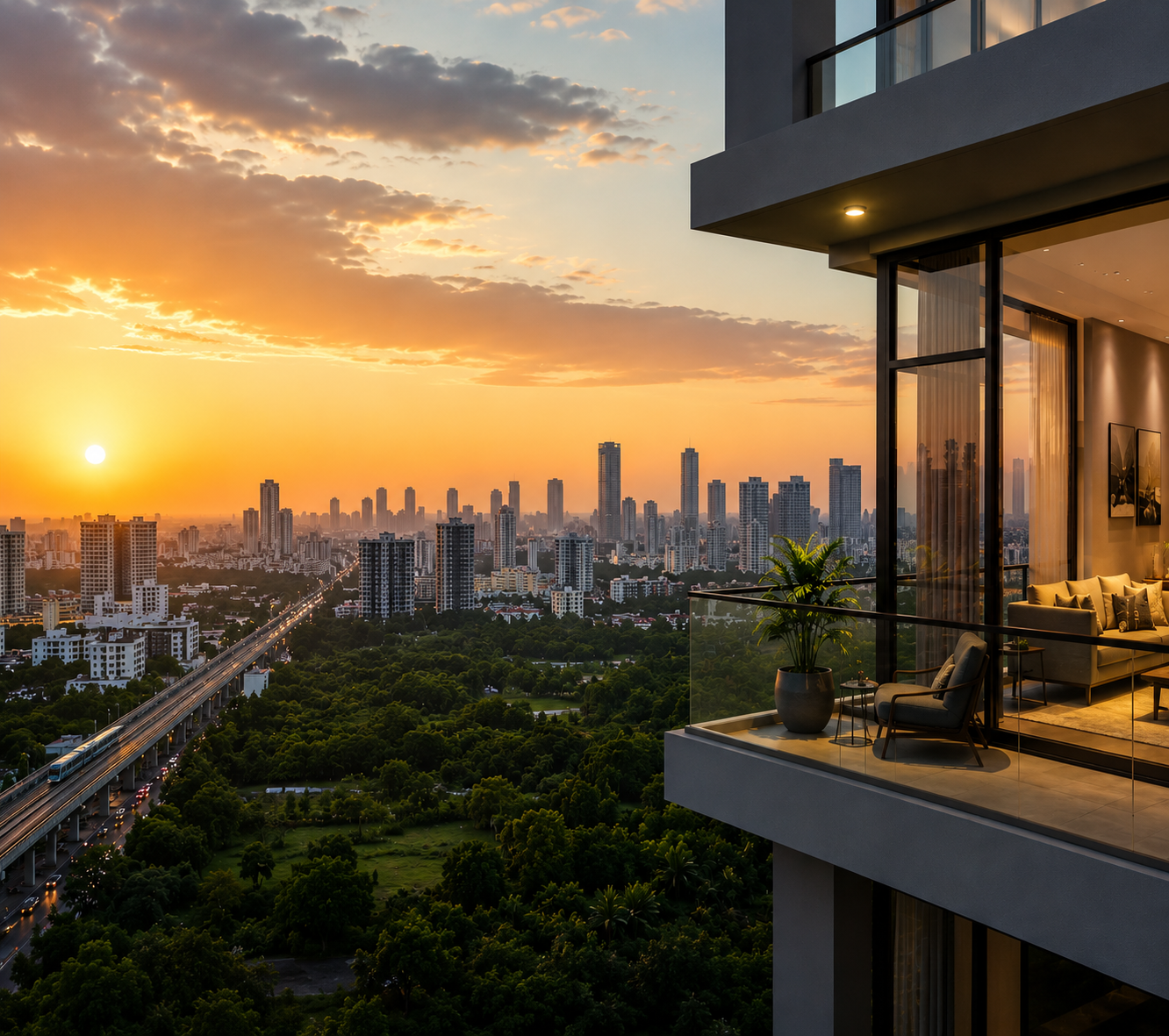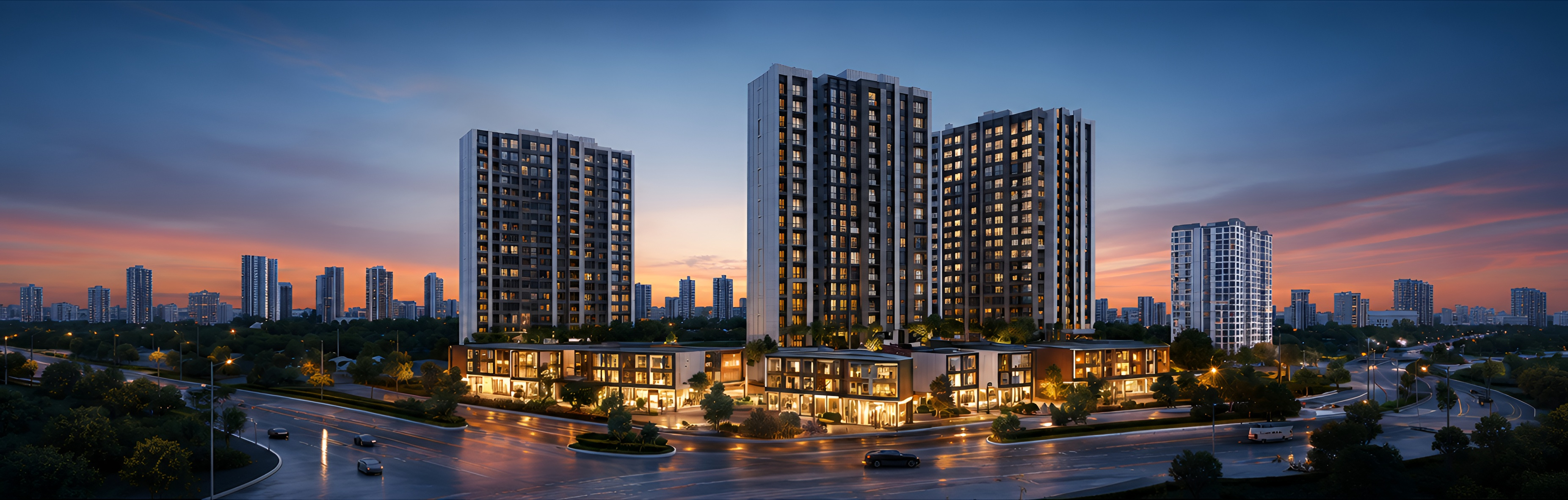
Priya and Karthik had been looking for a flat for nine months. Nine months of weekends in cars, nine months of sample flat tours, nine months of "we'll think about it." By the time they walked into a project in Nallagandla in late 2024, they were exhausted and ready to decide. The sample flat was beautiful. Marble floors, a view of the water body, a spacious balcony, and a sales executive who knew every question before they asked it. They put down a booking amount the same evening.
Three months later, when the final paperwork arrived and they actually read the project documents, something didn't add up. The "gated community" on the brochure had a 1.8-acre plot. There were going to be 240 units inside. The "clubhouse" was 3,500 sft. The "24-hour security" turned out to be one security camera at the gate. The swimming pool was shared between all 240 families.
They hadn't bought into a gated community. They had bought into a secured apartment building with a lobby they could call a clubhouse. The distinction matters, and Priya and Karthik didn't know to ask for it.
What "Gated Community" Actually Means
The term gated community gets used for everything from 12-unit secured complexes to 2,000-unit township projects. In Hyderabad's West corridor, where land is expensive and developers need to justify premium pricing, the phrase gets stretched far beyond its original meaning.
A real gated community — the kind worth paying a 20 to 30% premium for — has specific characteristics that can be measured before you sign anything:
- Minimum 4 to 5 acres of project land (anything less and the amenities exist on paper only)
- Clubhouse of at least 10,000 sft with genuinely functional spaces — not a decorated lobby
- Resident-to-amenity ratios that make sense — one swimming pool for 800 families is a shared bathtub
- Perimeter wall or fencing that actually encloses the property, not just a gate with a guard
- Professional security infrastructure: multi-point CCTV coverage, visitor management system, intercom to every flat
- Builder track record of completing and handing over comparable projects in Hyderabad
These aren't luxury requirements. They are the baseline for something that can legitimately call itself a gated community. The fact that hundreds of projects in Hyderabad fall short of this baseline while using the phrase freely is the trap most buyers walk into.
The Three Things Buyers Almost Never Check
In nine months of looking, Priya and Karthik had visited 22 projects. They had compared floor plans, argued over kitchen layouts, and calculated EMI scenarios for five different configurations. They had not, in nine months, done three things that would have changed their decision entirely.
1. Read the RERA Project Page
Every residential project in Telangana with more than eight units or more than 500 square metres of land area is legally required to be registered with RERA. The TSRERA (Telangana State RERA) website lists every registered project with the builder's stated project details, including the actual land area, number of units approved, timeline commitments, and any complaints filed against the builder.
The gap between what's in the brochure and what's on the RERA page is frequently instructive. Priya and Karthik's project showed 1.8 acres on RERA — exactly matching the brochure for once — but it also showed that the builder had delayed a previous project by 28 months. That's the kind of information that changes decisions, and it's available in five minutes online.
Go to TSRERA.telangana.gov.in, search by project name or RERA registration number (which the developer is required to display on all advertising), and look at the project details page. Key fields: land area, number of units, carpet area specifications, project end date, and the Complaints tab.
2. Calculated the Amenity-to-Unit Ratio
A project brochure listing 40 amenities means nothing without the denominator. 40 amenities for 80 families is a very different situation from 40 amenities for 800 families. The arithmetic is straightforward but almost nobody does it in the showroom.
The clubhouse is the most useful proxy. Take the total clubhouse area (in sft) and divide by the total number of units. Anything below 12 sft per unit and the clubhouse is functionally a common area, not a community facility. Above 20 sft per unit and you're in real gated community territory. Above 30 sft per unit and the project is genuinely investing in resident experience.
For the swimming pool, the relevant question is: how many units share this pool? At 200+ units per pool, the pool is a decorative feature. At under 100 units per pool, it's actually usable.
3. Visited on a Weekend Afternoon (Without Calling Ahead)
Sample flats are theatre. The purpose of a sample flat tour is to create a purchasing emotion, not to give you accurate information about what you're buying. The actual product is the existing community — the maintenance levels, the real security operation, the actual clubhouse condition — not the show flat.
If the project has existing occupied phases, visit on a Saturday at 4 PM without announcing yourself. Walk around the common areas. Talk to a resident or two. Watch how the security gate operates. Look at the maintenance of the existing common areas. This 90-minute visit will tell you more than six months of sample flat tours.
Why This Trap Is Getting Worse
Between 2022 and 2026, prices in West Hyderabad's prime micro-markets — Kokapet, Narsingi, Financial District — have risen between 35 and 55%. That pressure has two effects. First, it brings money into the market that makes buyers less price-sensitive and more susceptible to FOMO-driven decisions. Second, it encourages developers who previously built mid-market secured apartments to rebrand as "gated community" projects to justify new pricing levels.
The builder-to-broker-to-buyer chain also creates structural information problems. Brokers are typically paid 1 to 2% of the transaction value as commission, which creates an incentive to help buyers feel confident rather than to surface concerns. The information asymmetry between a developer who has built 15 projects and a buyer making their first purchase is enormous, and it rarely closes in the buyer's favour without effort.
The Questions to Ask Before Signing
Most buyers feel awkward asking hard questions in a sales environment. The antidote is having specific questions prepared that sound like due diligence rather than confrontation:
- What is the total project land area in acres — can you show me the RERA registration?
- What is the clubhouse size in sft and how many units will share it?
- How many units share the swimming pool?
- What is the OC status of the already-completed phases? Can I see it?
- What professional security company manages the property?
- What is the current monthly maintenance charge per sft in existing phases?
- Has this builder had RERA complaints filed against them in any previous project?
A developer who has nothing to hide answers all of these without hesitation. A developer who gets evasive or redirects to the brochure or tells you these questions will be answered after booking is telling you something important.
Every project in our portfolio has been reviewed for land area, RERA compliance, clubhouse-to-unit ratios, builder track record, and OC status where applicable. We do not list projects that do not meet the criteria for a genuine gated community, regardless of the commission involved. See our full project portfolio here.
What Priya and Karthik Did Next
They did not cancel. The cancellation clauses would have cost them the booking amount and more. Instead, they went into the purchase with clear expectations — this was a secured apartment building with a nice lobby, not a true gated community — and priced it mentally as such. They paid a premium they wouldn't have paid with full information.
Two years on, they're comfortable in the flat. But when their colleagues in a nearby genuine gated community describe weekend mornings at the clubhouse pool with their kids, or evening walks in the landscaped grounds, they understand what the extra ₹15 to 20 lakh would have bought them.
The nine months of research they did taught them about floor tiles and kitchen counters. The twenty minutes they should have spent on RERA would have taught them about the product they were actually buying.
How to Find a Real Gated Community in Hyderabad
The locations in West Hyderabad where genuine large-scale gated communities exist are relatively specific. Kokapet has the highest concentration of projects that genuinely meet the criteria — large land parcels, builders who have completed comparable projects elsewhere, clubhouses that match the claimed specifications. Gated community 3 BHK apartments in Hyderabad range from around ₹80 lakh at Tellapur to over ₹2.5 crore at Kokapet and Financial District.
For families, the location question overlaps with the school question and the commute question. The best gated communities for families in Hyderabad tend to cluster in a few zones — Kondapur, Gachibowli, and Narsingi — where good schools, manageable commutes to HITEC City and Financial District, and genuine community-scale projects all exist together.
The research process doesn't need to take nine months. It needs to be better-directed. Four visits to shortlisted projects, forty-five minutes on RERA, and one unannounced weekend afternoon site visit is enough to make a sound decision — if you know what to look for.
If you're still sorting through projects and want a shortlist built around your requirements — location, budget, timeline, family needs — reach out to us at +91 98487 25556 or visit our contact page. We have worked with buyers across every price point and neighbourhood in West Hyderabad, and we are happy to share what we know.
About Koiner Properties: We are a Hyderabad real estate agency based in Jubilee Enclave, Hitec City, specialising in verified gated community apartments and villas in West Hyderabad. We do not deal in open plots or standalone buildings. Learn more about us.